
Our Purpose
The SMaHT project would not be possible without the generous donor families who have provided such precious gifts to support this important work. We are grateful to them and their loved one’s legacy.
Genes are the instructions our cells use for building and repairing our bodies and controlling our day-to-day vital functions. Scientists know that certain gene changes change the normal instructions in a cell. When a cell’s normal instructions are changed, the changes can impact normal organ function or increase a person’s risk of diseases like cancer or heart disease. But, scientists don’t yet know exactly how the somatic (or non-inherited) gene changes do this or how to find these changes in a person’s body.
Research like the SMaHT project could help us understand more about people’s gene changes that are not passed down from their parents. The SMaHT project offers incredible potential for helping scientists discover how to treat and prevent many devastating diseases. Researchers in the SMaHT project are also trying to find better ways of finding gene changes early when they happen, so we can hopefully prevent some diseases in the future.

Donation Roadmap
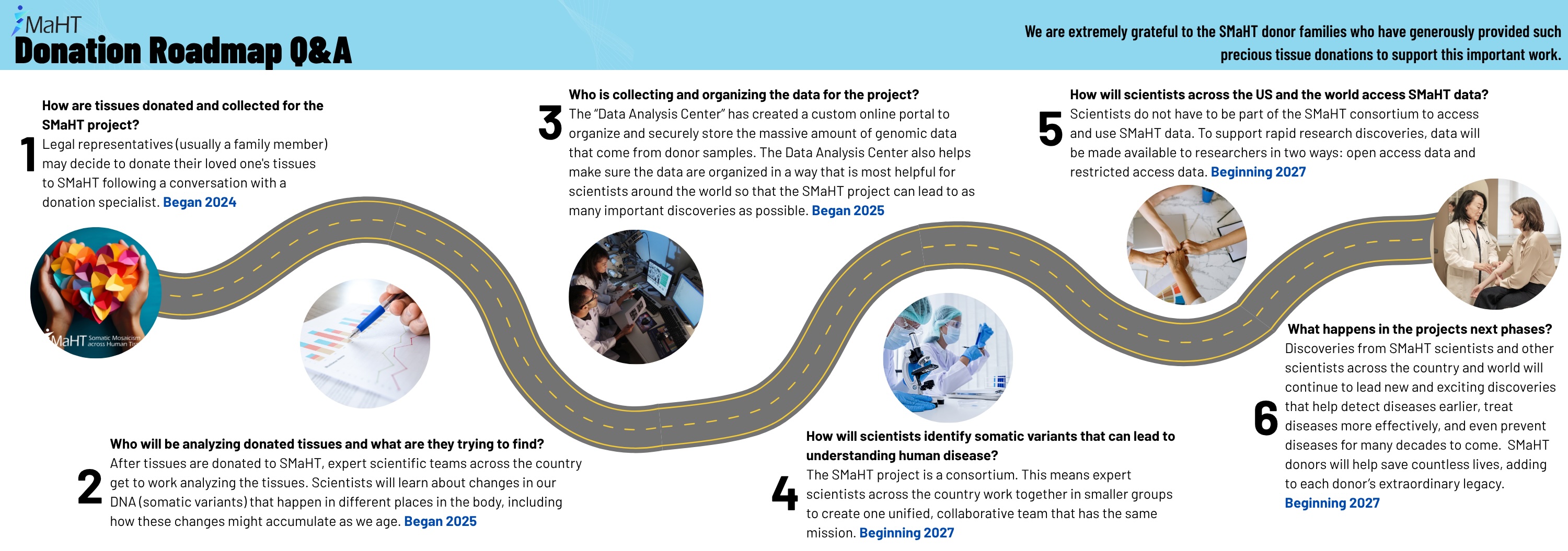
1: Click here to learn more:
The donation specialist explains the SMaHT project and asks if the family member would like to donate their loved one’s tissues to the project. If the family member agrees to the SMaHT donation, the donor can usually donate tissues from multiple different systems in their body. After the donation is complete, the study team carefully preserves each tissue, and the donor’s family can proceed with any funeral arrangements or other end-of-life arrangements they prefer. The study team members who help organize the donation process are from the “Tissue Procurement Center.”
2: Click here to learn more:
Usually, all of the cells in a person’s body have the same DNA. However, sometimes the DNA in one or more cells can change during a person’s lifetime. When this happens, the DNA that changed is called a “somatic variant.” The SMaHT project is trying to discover why and how some people develop somatic variants, and why some tissues might be more likely to develop somatic variants than others. SMaHT scientists also want to learn how we can detect somatic variants better to help predict and maybe even prevent many diseases.
Scientists can learn about a cell’s DNA by doing genome sequencing with the cell. For each SMaHT donor, scientists do genome sequencing from cells that come from multiple different tissues around the donor’s body. Doing genome sequencing with cells from many different tissues can help the scientists discover which of the donor’s tissues and organs develop the most somatic variants.
After SMaHT scientists do genomic sequencing with cells from the donor’s different tissues, the scientists enter what they found into a database. The scientific teams who initially analyze the donated tissues to do genome sequencing are called the “Genome Characterization Centers.”
4. Click here to learn more:
The scientific teams who initially analyze the donated tissues to do genome sequencing are called the “Genome Characterization Centers. Some of the smaller groups of scientists are called Tool and Technology Development teams. Together these teams will develop, test, and use innovative technology to figure out the most cutting-edge, efficient ways to find somatic variants. Then, they use their newly developed technology to analyze the data, look for patterns, and find somatic variants across different tissues and donors.
5. Click here to learn more:
First, some data will be freely accessible on the SMaHT data website. All data that are freely accessible are non-identifying, which means researchers could not use the freely accessible data to figure out who a donor is. Second, some more sensitive data, including basic information about each donor’s health history, will be available to approved researchers in a secure database. Researchers will have to apply and be approved to access the secure database to maintain donors’ privacy and minimize any possibility of being able to identify a specific donor.